You've probably been creeped out by this. You Google something, maybe thinking about a gift for your sweetie. Then you start noticing ads for that showing up in your Facebook feed. Or wondered how the damnyouautocorrect works. Or how Neflix knew that House of Cards was going to be a hit. Or why England had a monetary crisis in the late 1600's. Well, maybe not that last one.
AIQ by Nick Polson and James Scott will tell you why in clear readable language, plus a little tiny wee almost minuscule bit of math, in an easy, reader friendly manner. Really, it's all good.
So for example, where they use math and I won't. The monetary crisis. Most people know the problem with silver coins back in the day is they were subtly different sizes and weights. People would shave off a sliver and pass the coin. Again and again. Better manufacturing and milled edges made that more difficult.
Then there's the possibility that if the coins are supposed to be a certain weight, within a certain tolerance over or under, what's to stop the people in the mint from issuing coins that were ever so slightly on the under side, and pocketing the difference?
It turns out they were using the wrong formula in the Trial of the Pyx to figure out if there was a problem. They had one of the smartest guys in history in charge, Isaac Newton, and he missed it. They didn't know that the size of your sample is important. (I'm sparing you the math, even though it's easy, but because I don't want to play with the Greek letters on this keyboard. After all, I've only had one coffee as I'm writing this.)
And autonomous cars, how do they know where they are? This is critically important. In order to navigate to some other place, a car needs to know exactly where it is now, and now again, and again, and again, many times every second. Humans do this too, some better than others, making tiny corrections to the controls to stay in the driving lane, and a safe distance from other vehicles. Humans do it much slower, of course.
It isn't just GPS. That isn't accurate enough. It isn't just LIDAR either. There's lots of math and something called Bayes's Rule or Bayesian search. It's how they found the USS Scorpion, and part of how autonomous cars work, and medical testing, and so much more. It's a form of updating your prior knowledge in light of new evidence.
As a side note, you should know it's taking everything I have to avoid springing into a full blown rant about how many people go about their daily life, oblivious to the relevant facts. It's my personal opinion this is how people vote for politicians who are a menace. I can get why rich white men vote for rich white male politicians who will enact policies favourable to rich white men. I hate it, but I understand it.
But why do other people vote for them? Why do women vote for men who restrict family planning choices and limit their professional lives, who demean them in public? Why do poor people vote for rich people who make things harder for the poor?
I get that you could be fooled by someone saying they are going to enact legislation to do x, y, and z, and they actually does the opposite. Once. But many politicians come right out and say what they are going to do. Kenney, for example. Nobody should be expressing surprise at what his political party is up to. There's a joke. A rich banker, a middle class white collar worker, and a blue collar union worker meet up to discuss issues. While the white and blue collar workers are off getting a coffee and discussing how to gang up on the banker, the banker is stuffing doughnuts down his throat and into his pockets. The two others come back to find the box of a dozen doughnuts has only one left, and the banker tells the white collar worker, "You'd better watch that union guy, he's going to eat your doughnut. In this joke, Kenney is the meeting moderator, and he helped snarf the doughnuts and pass them to the banker, and distract the workers.
(Thinks calming thoughts.) Back to the book. Math, constantly updated predictions based on current evidence, done by computers who can deal with a statistical universe far larger than humans can comprehend, is how Amazon decides what to show you as suggested purchases. Based on what you buy, it compares you to other people. So if you like a certain set of movies, for example, it looks at all the other people who like that set of movies, and it compares what they buy that you have not bought. Voila. Of course, it's much more detailed and complicated than that.
Humans make their judgments on a very limited data set. It's basically what we see and hear. There's a limit how much input we have available to us, and how much we can actually absorb. It's easy to make a false conclusion based on data that is not representative of the larger set, and that's before deception, and fraud, and manipulation, and theft.
That's why these big data sets are so important. Consider images of skin cancer. What does that look like? How do you compare a deadly melanoma from a benign mole? If caught early by a trained dermatologist, the cancers are often treatable, so the stakes are high. If your comparison database is small, or doesn't contain good examples, you are likely to make mistakes. But what if there were many images, from many different kinds of cameras, under many different lighting conditions? Such an AI system can distinguish the two most common types of skin cancer from each other, and from a benign mole, and what's more, do so as accurately as a panel of dermatologists. Even more important, do it much faster. It may soon be possible to send in an iPhone photo of a suspect patch of skin, and get an answer back in real time.
Right now a Formula 1 race car generates enormous amounts of data every lap of a race. That's analyzed to determine what tiny changes need to be made to make the car go faster. Tiny fractions of a second add up. Lots of money is at stake.
So why aren't we getting the same sort of analysis done our health? It's literally life and death to us to get a grip on the patterns of our changing health results. Seeing a trend early can get treatment that is likely to be cheaper and more effective, leading to lower medical costs and longer better lives for us.
So, why don't we? Privacy concerns is one reason. The other is that the data is not organized well, and nobody is really looking at any of it. You know who Florence Nightingale is, right? She didn't get the results she did by asking nice and smiling. She had data because she loved math, and in particular, statistics. That data eventually brought about the changes.
Right now you are lucky if you see your family doctor once a year for less than a half hour. They rely on your oral history about health in your family. But really, what do you know of your parent's health? Your grandparents? Maybe you have a genetic predisposition to something, and the people you inherited it from died in farm accidents before that could kick in. You are much less likely to die in a farm accident, and much more likely to die from a cardiovascular disease, or a cancer, that is, if you survive driving.
There is great promise in genetic analysis to aid diagnoses and treatment of many conditions. Knowing your parents genetic history makes that analysis even more accurate. Knowing what similarities are important or not, it becomes possible for the Netflix of medical systems to happen. Your doctor would get told, there is a chance your patient has this condition or is at risk for these, we suggest these particular tests.
Some of you are going, Hell yes! Others are horrified. Fair enough. There would need to be lots of controls on that sort of thing. I'd worry about the insurance industry seeing this data about us and manipulating the industry to make more money, or deny coverage. But mainly the making more money part. The Orwellian implications are obvious.
What's important to realize is that this isn't going away. If we don't want that Orwellian insurance world, we're going to have to make the politicians enact legislation to prevent it, and a system that can enforce those regulations, and do it in the face of lobbying by deep-pocketed industries. We goofed on cell phones, and Canadians pay some of the highest rates in the world. Do you want to get it wrong on your health?
As a reward for reading through the giant wall of text, here's the real stars of the blog, hard at it.
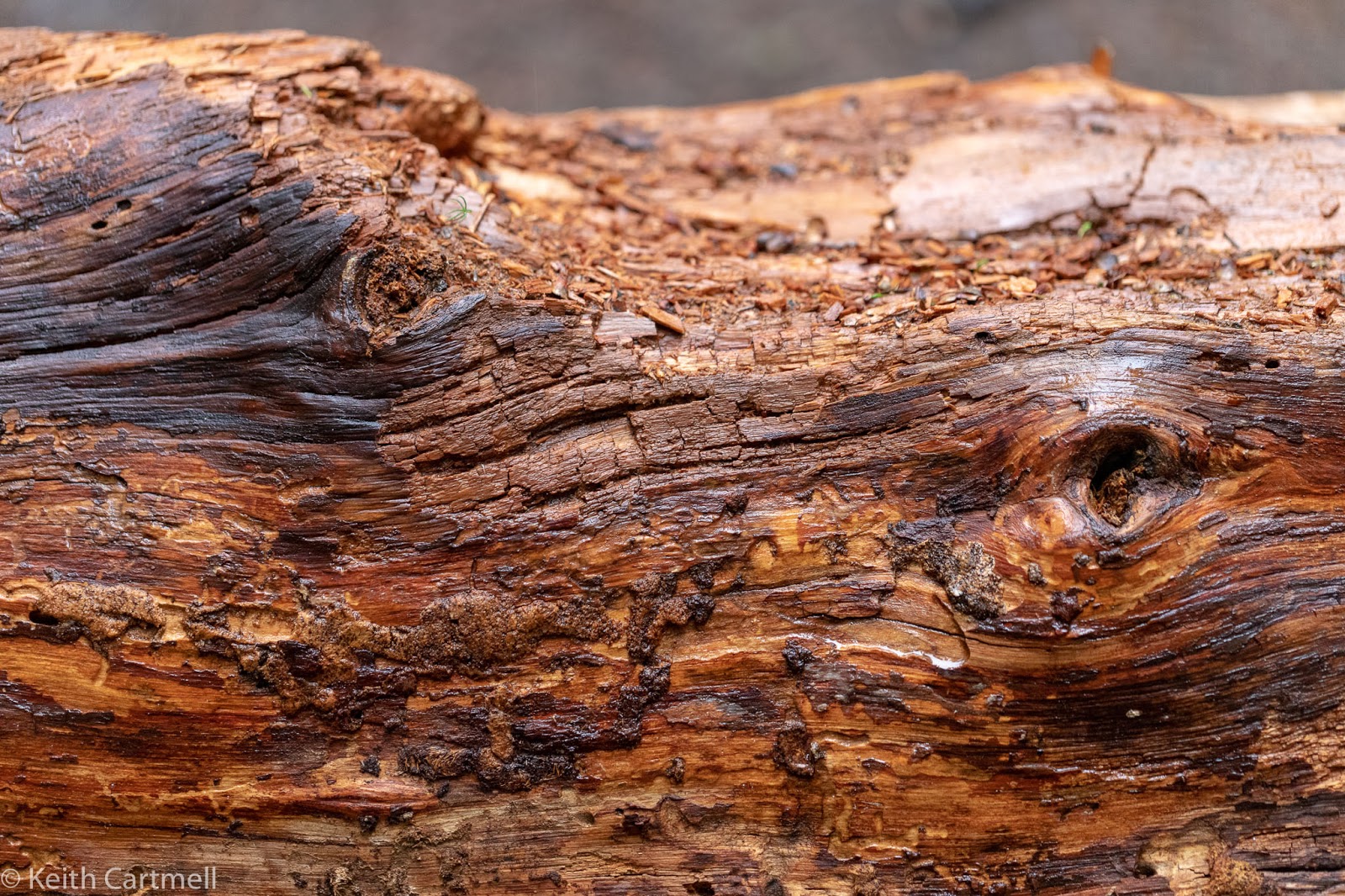
Deadwood of the Day
Friday, December 20, 2019
Thursday, December 19, 2019
Sunrise near Banff
My buddy Sean invited me to join him on a trip out to Banff area for some sunrise shots. He had a place in mind, and since I've not been to Banff much, it was all good to me. Alas, the actual sunrise was nothing to write home about. I didn't see that tiny hit of colour at the time. I'm guessing that's because I was looking down at the camera for that few seconds.
These next two are the ones I like most from the pre-breakfast part of the shoot. I love the 50's pastel colour of the dock, and the light was really nice.
It took a couple of tries to get the shots right for the panorama, and even more to decide exactly how to edit it. 20700 x 6176 px or about 6 feet x 2 feet for a highly detailed print.
Then on the way home the light got really good and we pulled off the highway several times.
This one is special for me because I dropped it into Photoshop to remove a big ugly street light pole. Even more special? No swearing.
In the image serendipity department, we have the lovely and triumphant Michelle!
Deadwood of the Day
These next two are the ones I like most from the pre-breakfast part of the shoot. I love the 50's pastel colour of the dock, and the light was really nice.
It took a couple of tries to get the shots right for the panorama, and even more to decide exactly how to edit it. 20700 x 6176 px or about 6 feet x 2 feet for a highly detailed print.
Then on the way home the light got really good and we pulled off the highway several times.
This one is special for me because I dropped it into Photoshop to remove a big ugly street light pole. Even more special? No swearing.
In the image serendipity department, we have the lovely and triumphant Michelle!
Deadwood of the Day
Wednesday, December 18, 2019
...and all I got was
That's the punch line to many a joke, but it's true for me yesterday. I was out for a photo ramble and the only photo I came back with that I liked even slightly was this one. Another really good thing happened that I can't talk about, so it wasn't a total loss.
Deadwood of the Day
Deadwood of the Day
Tuesday, December 17, 2019
Abstract cats
Well, one of them anyway.
Celina was being her normally chatty self, talking to me with her head upside down.
Curtis was asleep. It was all I could do not to dive into his tummy and motorboat him.
And for good measure, both together, shot a few days ago. Curtis had just pulled his head out from beneath the quilt. I think they know when I pick up the camera. Sometimes they care, sometimes not.
Deadwood of the Day
In the same file number serendipity department.
Celina was being her normally chatty self, talking to me with her head upside down.
Curtis was asleep. It was all I could do not to dive into his tummy and motorboat him.
And for good measure, both together, shot a few days ago. Curtis had just pulled his head out from beneath the quilt. I think they know when I pick up the camera. Sometimes they care, sometimes not.
Deadwood of the Day
In the same file number serendipity department.
Monday, December 16, 2019
A little over 50 years ago, this
And it was a major this. One of the most major this's that have ever happened.
I was just a kid. My parents let me stay up to watch those first steps on the moon. I don't think I grasped how big of a deal it was back then. Since then I've learned more about the space program, and followed it in a general way. Remember, when Kennedy declared their goal was to land a man on the moon and return safely to earth before the end of the decade, American's hadn't even put a man in orbit. Eisenhower thought he was crazy.
In fact, they didn't even know everything they didn't know about what would be required. There was no rocket that could get to the moon, let alone return. They didn't have a machine to actually land on the moon. They didn't even know how to calculate the required course trajectories, and no existing computer could do the calculations fast enough.
Whatever they built, they knew it had to function perfectly. First time, every time, with lives at stake and the world watching. The number of things that could go wrong with catastrophic results were countless. The procedures to design, build, test, and actually use everything required are almost more remarkable than what they actually built. Often they had to design and build the tools that would be required to build the actual machines. Sometimes it was extremely skilled hand work.
Doing that, in many ways helped create our digital world. NASA bet big on digital integrated circuit computers, and it worked. By our standards the Apollo Guidance computer is barely a calculator, yet it was one of the smallest and most sophisticated computers in existences. The only ones better were the mainframe guidance computers on the ground. Our cell phones have millions of times more memory, and nearly as many times processing power. That was then, this is now. We needed then, to get to now.
This movie is a homage to the incredible effort put in by many thousands of people to get it done right. It's also a blast from the past, showing ordinary people gathering to watch the liftoff. Best of all, the colour and detail are amazing! I remember the images on TV being fuzzy black and white. These are in colour, clear, sharp, and amazing.
I had this on hold for nearly a year, and it was worth it.
Then there was these two.
I wasn't really in the mood. Meh.
Deadwood of the Day
Now we're into July. This is from a trip out the Sheep River valley.
I was just a kid. My parents let me stay up to watch those first steps on the moon. I don't think I grasped how big of a deal it was back then. Since then I've learned more about the space program, and followed it in a general way. Remember, when Kennedy declared their goal was to land a man on the moon and return safely to earth before the end of the decade, American's hadn't even put a man in orbit. Eisenhower thought he was crazy.
In fact, they didn't even know everything they didn't know about what would be required. There was no rocket that could get to the moon, let alone return. They didn't have a machine to actually land on the moon. They didn't even know how to calculate the required course trajectories, and no existing computer could do the calculations fast enough.
Whatever they built, they knew it had to function perfectly. First time, every time, with lives at stake and the world watching. The number of things that could go wrong with catastrophic results were countless. The procedures to design, build, test, and actually use everything required are almost more remarkable than what they actually built. Often they had to design and build the tools that would be required to build the actual machines. Sometimes it was extremely skilled hand work.
Doing that, in many ways helped create our digital world. NASA bet big on digital integrated circuit computers, and it worked. By our standards the Apollo Guidance computer is barely a calculator, yet it was one of the smallest and most sophisticated computers in existences. The only ones better were the mainframe guidance computers on the ground. Our cell phones have millions of times more memory, and nearly as many times processing power. That was then, this is now. We needed then, to get to now.
This movie is a homage to the incredible effort put in by many thousands of people to get it done right. It's also a blast from the past, showing ordinary people gathering to watch the liftoff. Best of all, the colour and detail are amazing! I remember the images on TV being fuzzy black and white. These are in colour, clear, sharp, and amazing.
I had this on hold for nearly a year, and it was worth it.
Then there was these two.
I wasn't really in the mood. Meh.
Deadwood of the Day
Now we're into July. This is from a trip out the Sheep River valley.
Sunday, December 15, 2019
The Camera Never Lies, or does it
So that was an excellent book!
The story is that a man inherits a film camera from his grandfather. It's a very special camera, in that it shows the truth. This proves to be difficult for the man, as he is concealing lies, and some of them involve a difficult family situation. Plus co-workers. Plus an editor determined to get the book that she has paid for. At first he thinks someone is faking it during the developing process, or that he's being set up for blackmail.
The first couple chapters hooked me. After supper I read it straight through in one go. It's trite to say that all is not as it seems, but the problems keep piling up for our guy, and he keeps making things worse by trying to run away. I can just see the writer thinking as he started each chapter, now what's the worst that could happen now?
It isn't a long or difficult read, but I found it enjoyable. As a writer I might have tightened up the ending a little, tied up some loose ends, and maybe put the characters through it a little more. But it made me think about what secrets I keep, and the secrets that others keep. Is keeping them a good idea?
It used to be that certain things were kept private, and for good reason. Not that long ago it would be catastrophic for a prominent person to be outed as gay. For a while having Aids was the same, or telling people you had cancer, especially in some 'unmentionable' body part. Now a person might be cautious about sharing those things depending on their exact situation, but it's no big deal in Canada for a person to introduce another person of the same sex as their spouse. Some of the LRT conversations I've been inflicted with have astonished me. You don't want to know.
The internet has been a great leveller, to say nothing of cable TV shows. Imagine Game of Thrones as a movie series back in the day, before cable TV, before video tape was common. When if you wanted to see a movie you went to the movie theatre. How would Game of Thrones be classified? R at the least, and probably as pornography. Maybe even snuff if people couldn't figure out how some of the deaths were done, what with our mad skillz with CGI.
"Let your freak flag fly." It's when you are comfortable enough to be yourself in front of others. There is less said about the comfort level of those around the flag flier. Even now, after more than 40 years of Pride Parades, there are still politicians who won't attend one. I think they're wrong, and suspect their reluctance springs from a lack of comfort with themselves, or fear of what other people will think of them.
After all, wouldn't you have to be gay to attend a Pride parade? Wouldn't you have to be Muslim or a sympathizer to support Muslim immigrants? You must be a criminal to argue that people accused of crimes have rights and due process, and that the death penalty is wrong. There are still people who think like that. It's sad.
When you think about what someone might want kept private, and how they would feel if it became known, a lot depends on exactly what it is. Being discovered cheating a client or on your taxes might be the kiss of death if you're an accountant, but a badge of pride if you're some anti-government nut bar. Having other people find out you've got a foot fetish and red leather boots turn you on is probably not the end of the world, but some people might look at you funny. Then again, given what turns up on the internet, a foot fetish is practically mainstream now. It's no big deal to tell work you need a day off because you're going in for a colonoscopy, but nobody wants the details.
Things were kept secret in the past mainly because of moral judgements. Fear of what other people might say because they, of course, were all normal (whatever that means) and you were the only freak. So of course you would keep quiet about anything that wouldn't seem 'normal'. The establishment (The Church, Media, elected politicians, the rich) would fiercely defend the status quo. Not that they wouldn't indulge in their own vices in private.
Part of the point the book makes is that some secrets need to be discussed with certain others because it directly concerns them. If your kid is starting to fail school, both parents need to be talking to the teacher and figuring out how to fix the problem. If you're having marital problems best to deal with them. If your position in society is built on a lie, you need to be prepared to lose that place on society's terms, or come clean and take what comes.
I picked the book up just for the title, because of course, our cameras tell lies all the time. Every photo is a lie. What they capture on a digital sensor, or on film is only an approximation of what our eyes see, which itself is an approximation of reality. Even the 'what our eyes see' is a problem, mainly because we see different things. Colour blindness is only one example.
Here's some images straight out of my camera, no changes in Lightroom. Are they all true?
Deadwood of the Day
All the same log, so I figured I'd give you a triple dose, to match the triple dose above.
The story is that a man inherits a film camera from his grandfather. It's a very special camera, in that it shows the truth. This proves to be difficult for the man, as he is concealing lies, and some of them involve a difficult family situation. Plus co-workers. Plus an editor determined to get the book that she has paid for. At first he thinks someone is faking it during the developing process, or that he's being set up for blackmail.
The first couple chapters hooked me. After supper I read it straight through in one go. It's trite to say that all is not as it seems, but the problems keep piling up for our guy, and he keeps making things worse by trying to run away. I can just see the writer thinking as he started each chapter, now what's the worst that could happen now?
It isn't a long or difficult read, but I found it enjoyable. As a writer I might have tightened up the ending a little, tied up some loose ends, and maybe put the characters through it a little more. But it made me think about what secrets I keep, and the secrets that others keep. Is keeping them a good idea?
It used to be that certain things were kept private, and for good reason. Not that long ago it would be catastrophic for a prominent person to be outed as gay. For a while having Aids was the same, or telling people you had cancer, especially in some 'unmentionable' body part. Now a person might be cautious about sharing those things depending on their exact situation, but it's no big deal in Canada for a person to introduce another person of the same sex as their spouse. Some of the LRT conversations I've been inflicted with have astonished me. You don't want to know.
The internet has been a great leveller, to say nothing of cable TV shows. Imagine Game of Thrones as a movie series back in the day, before cable TV, before video tape was common. When if you wanted to see a movie you went to the movie theatre. How would Game of Thrones be classified? R at the least, and probably as pornography. Maybe even snuff if people couldn't figure out how some of the deaths were done, what with our mad skillz with CGI.
"Let your freak flag fly." It's when you are comfortable enough to be yourself in front of others. There is less said about the comfort level of those around the flag flier. Even now, after more than 40 years of Pride Parades, there are still politicians who won't attend one. I think they're wrong, and suspect their reluctance springs from a lack of comfort with themselves, or fear of what other people will think of them.
After all, wouldn't you have to be gay to attend a Pride parade? Wouldn't you have to be Muslim or a sympathizer to support Muslim immigrants? You must be a criminal to argue that people accused of crimes have rights and due process, and that the death penalty is wrong. There are still people who think like that. It's sad.
When you think about what someone might want kept private, and how they would feel if it became known, a lot depends on exactly what it is. Being discovered cheating a client or on your taxes might be the kiss of death if you're an accountant, but a badge of pride if you're some anti-government nut bar. Having other people find out you've got a foot fetish and red leather boots turn you on is probably not the end of the world, but some people might look at you funny. Then again, given what turns up on the internet, a foot fetish is practically mainstream now. It's no big deal to tell work you need a day off because you're going in for a colonoscopy, but nobody wants the details.
Things were kept secret in the past mainly because of moral judgements. Fear of what other people might say because they, of course, were all normal (whatever that means) and you were the only freak. So of course you would keep quiet about anything that wouldn't seem 'normal'. The establishment (The Church, Media, elected politicians, the rich) would fiercely defend the status quo. Not that they wouldn't indulge in their own vices in private.
Part of the point the book makes is that some secrets need to be discussed with certain others because it directly concerns them. If your kid is starting to fail school, both parents need to be talking to the teacher and figuring out how to fix the problem. If you're having marital problems best to deal with them. If your position in society is built on a lie, you need to be prepared to lose that place on society's terms, or come clean and take what comes.
I picked the book up just for the title, because of course, our cameras tell lies all the time. Every photo is a lie. What they capture on a digital sensor, or on film is only an approximation of what our eyes see, which itself is an approximation of reality. Even the 'what our eyes see' is a problem, mainly because we see different things. Colour blindness is only one example.
Here's some images straight out of my camera, no changes in Lightroom. Are they all true?
Deadwood of the Day
All the same log, so I figured I'd give you a triple dose, to match the triple dose above.
Saturday, December 14, 2019
First frosty semi-macro
I'd never tried taking snowflakes before. As I was doing something else outside I noticed these lovely ice and snow structures, and ran for the camera. Note these are not specifically snowflakes. I was more aiming for the bridge like structures I saw. I'll have to do more of this; it was fun.
1.
2.
3.
4.
5.
6.
7.
Deadwood of the Day
1.
2.
3.
4.
5.
6.
7.
Deadwood of the Day
Subscribe to:
Comments (Atom)